
How Does Homeostasis Happen?
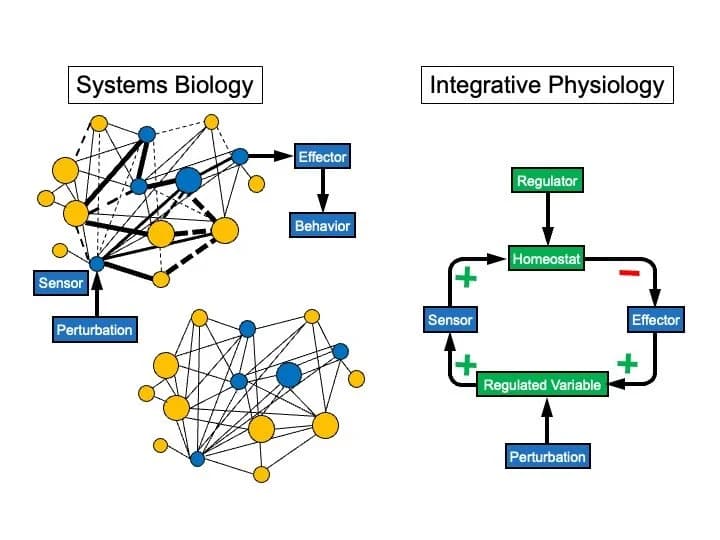
This perspective piece examines two complementary approaches to understanding how the body maintains stable internal conditions: integrative physiology and systems biology. Both aim to explain homeostasis, but they differ fundamentally in method and scope.
Integrative physiology takes a top-down approach, studying how organ systems coordinate to maintain internal stability. It emphasizes regulatory mechanisms such as the autonomic nervous system, the hypothalamic-pituitary-adrenal axis, and feedback loops that keep variables like blood pressure, temperature, and glucose within viable ranges.
Systems biology, by contrast, works from the bottom up, using computational and mathematical modeling of molecular networks to understand emergent properties of biological systems. The article explores how reconciling these two perspectives can advance our understanding of health, disease, and the complex processes that keep us alive.
Key Takeaways
- Compares top-down integrative physiology with bottom-up systems biology
- Explores how the autonomic nervous system and feedback loops maintain homeostasis
- Argues for reconciling both approaches to advance understanding of health and disease